SB 52: Existing Vacancies (Publication) Bill, 2015
Download Bill Bill Analysis Download Bill Analysis Infograph
Sponsor:
Sen. Biodun Olujimi
State:
EKITIParty:
Peoples Democratic PartyBill Status: Awaiting Committee Report
- First Reading: 16/06/2016
- Second Reading: 11/10/2017
- Committee Referred To: Establishment and Public Service Matters
- Consolidated with:
- Date Reported out of Committee:
- Third Reading:
- Reconsidered and Passed:
Bill Analysis:
SHORT TITLE
Existing Vacancies in the Federal Civil Service (Prohibition) Bill 2015
OBJECTIVE OF THE BILL
The Bill seeks to promote integrity and transparency in the recruitment of personnel into the Federal Civil Service by making it an offence for a Federal Ministry, agency or parastatal to fill existing vacancies in their organizations if such vacancies have not been advertised publicly.
NUMBER OF PARTS/CLAUSES AND CONTENTS
There are 5 Clauses with an interpretation part and citation
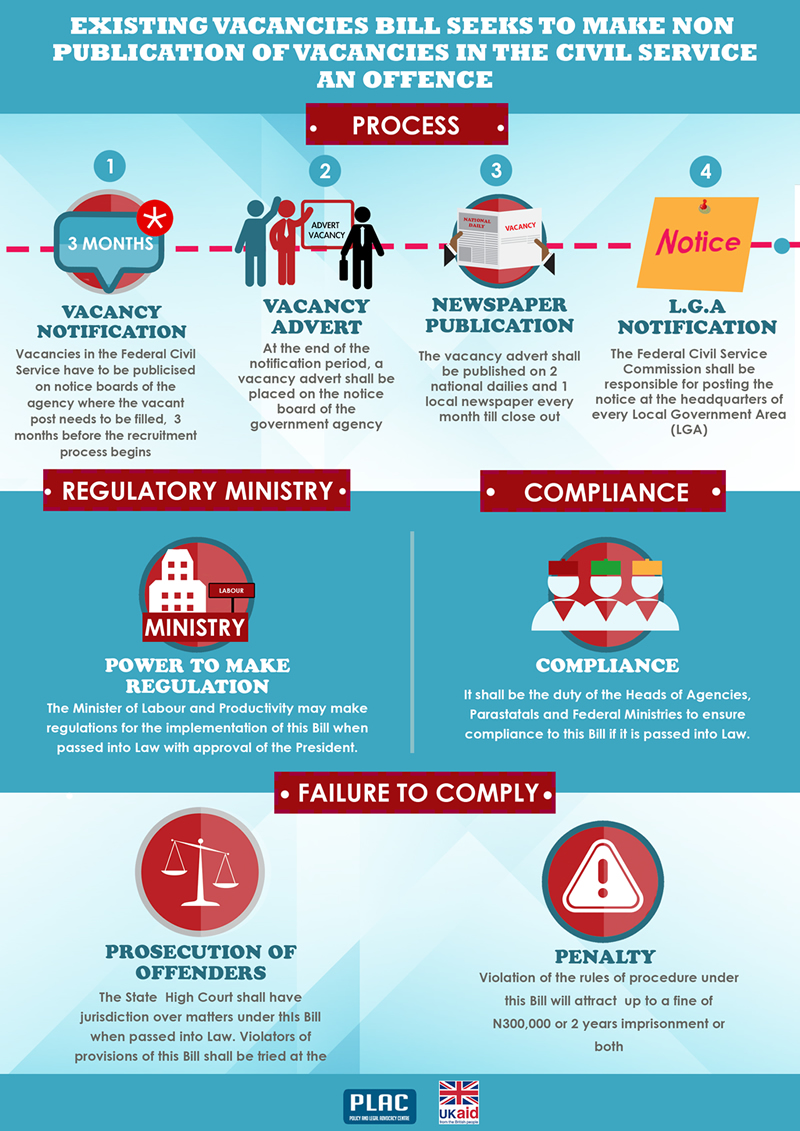
Clause 1 – it is an offence for vacancies not to be publicized 3 months before recruitment exercise commences and it is the duty of the head of government agencies and ministries to ensure compliance
Clause 2 – violation of part one attracts a fine of not more than N300,000 or up to 2 years imprisonment or both
Clause 3 – vacancies in the Federal Civil Service shall be published on two national dailies and one local newspaper of each state on a monthly basis. They shall also be published on notice boards of each local government headquarters
Clause 4 – State High Courts shall have jurisdiction over matters of non-compliance
Clause 5 – the Minister of Labor and Productivity may make regulations with the President’s approval
IMPLICATION AND CONSEQUENCE OF THE BILL
Offence Under The Law: Recruitment into the Federal Civil Service without due process would become an offence punishable by fine, jail term or both.
Effect to the Federal Character Commission: - The 1999 Constitution gives the Federal Character Commission (FCC) the power to equitably spread and monitor proportional sharing of all bureaucratic posts at all levels of government (Third Schedule, Section 8(1)). The FCC is further empowered under the Federal Character Commission Act (Section 4(1)(g)) to ensure that Ministries, agencies and government departments have clear procedure for employment. The Bill appears to give effect to these provisions and seeks to establish a more open and inclusive process in employment into the federal civil service.
CONCLUSION
The Bill is part of an effort to curb secret recruitment exercises in the public sector. The procedures and timeline set in the Bill will definitely make recruitment processes longer but will ensure transparency and equitable representation, as every state will be timely notified.
Infographic: